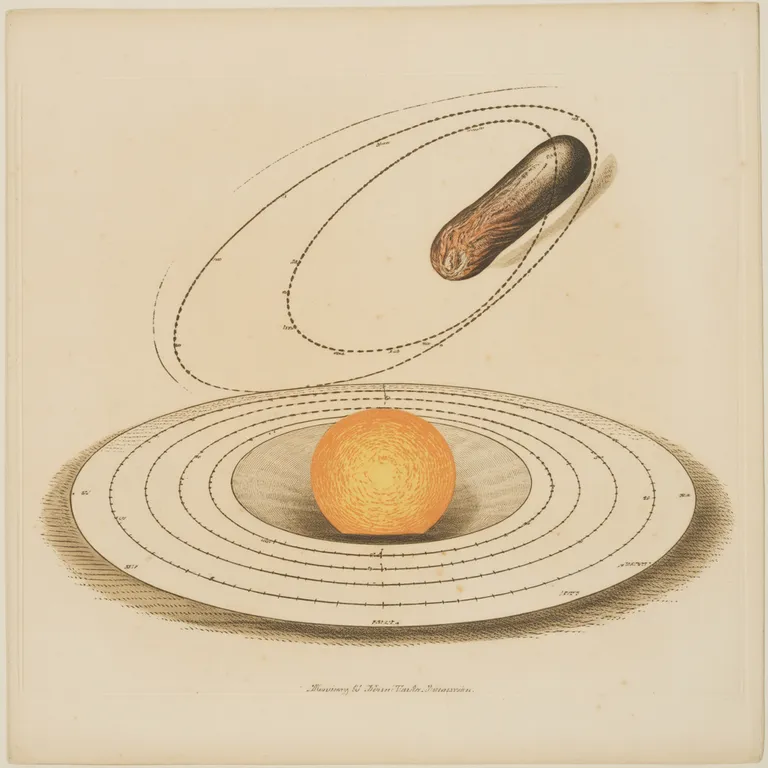
It left the solar system faster than gravity says it should.
'Oumuamua was the first interstellar object humans have ever observed inside our solar system. It passed through in late 2017 at speeds that placed it firmly on a hyperbolic exit trajectory — and then it accelerated on the way out, leaving the Sun's neighborhood faster than gravity alone predicts. The leading explanation is outgassing from a comet-like body, but no coma, no tail, and no spectral signature of outgassing were observed. By the time anybody could point a serious instrument at it, it was already gone. No second interstellar object since has had the same anomalous acceleration.
On March 16, 2026, 3I/ATLAS — the third interstellar object ever confirmed — swept through Jupiter's Hill sphere at 53.4 million km, the closest any interstellar object has come to a major planet on record. Discovered by ATLAS in July 2025, its eccentricity of 6.14 dwarfs Oumuamua (1.2) and Borisov (3.36). Breakthrough Listen's 1–12 GHz scan returned a clean null. Here's what the flyby actually showed.
On October 19, 2017, a Hawaiian telescope caught the first object ever confirmed to come from outside our solar system. 'Oumuamua was weirdly elongated, tumbling, reddish — and it sped up on the way out with no comet tail to explain why. Most astronomers say faint outgassing. One Harvard scientist says: don't rule out that it was built.
On August 15, 1977, the Big Ear radio telescope picked up a 72-second narrowband burst at 1420 MHz — the hydrogen line, SETI's canonical frequency for a deliberate broadcast. The signal was 30 times background. It came from the direction of Sagittarius. It has never been heard again. Astronomer Jerry Ehman wrote 'Wow!' in the margin. Forty-eight years later, the printout is still the strongest unexplained candidate technosignature on record.