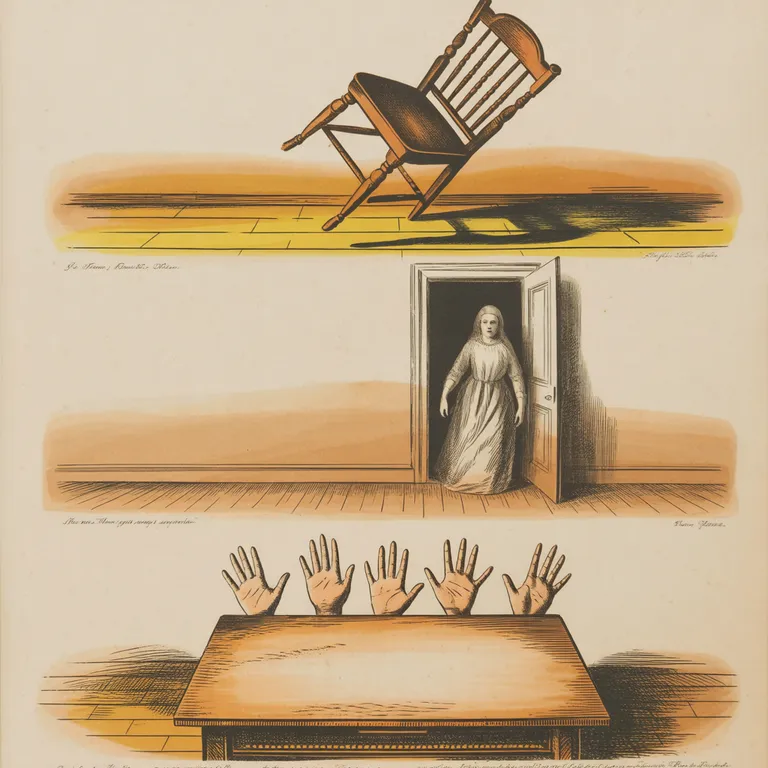
The Enfield case file is roughly a thousand pages.
Paranormal investigations live in a strange category — too witnessed to dismiss, too unreplicable to publish. The Enfield poltergeist haunted a council house in north London for 18 months in 1977–79. Two investigators from the Society for Psychical Research filed 180 hours of audio, photos, and statements from 47 witnesses including two policemen. Their published conclusion: they believed something real happened. The case file remains the most thoroughly documented poltergeist investigation on record.
Including two policemen and a press photographer.
Beginning August 30, 1977, the Hodgson family at 284 Green Street in Enfield, North London reported moving furniture, knocking noises, and disembodied voices that lasted roughly fourteen months. Two investigators from the Society for Psychical Research were present for most of it, recording about 1,500 incidents. A police constable signed a statement saying she saw a chair move on its own. Some events were later admitted to have been faked. Others were not.
On November 13, 1974, Ronald DeFeo Jr. murdered six members of his family at 112 Ocean Avenue, Amityville — a real and tragic crime for which he was convicted. The 'haunting' came later: the Lutz family fled after 28 days in 1975-76, and Jay Anson's 1977 bestseller made the house infamous. But DeFeo's own attorney admitted the story was 'created over many bottles of wine,' and investigators found the paranormal claims unsupported.
The German state telephone company tried to disprove a haunting and ended up itemizing one on a bill: the speaking clock in a Bavarian law office was dialed dozens of times in fifteen minutes, on rotary phones that physically could not dial that fast.
The Bell Witch is one of America's most famous ghost legends, set on the John Bell farm near Adams, Tennessee, around 1817 to 1821. As the story goes, an unseen entity called 'Kate' tormented the family, afflicted daughter Betsy, and was even blamed for patriarch John Bell's 1820 death. But there is no contemporary record of any of it — the tale rests almost entirely on a newspaper editor's 1894 book and a family manuscript no one has ever produced.