
'Oumuamua
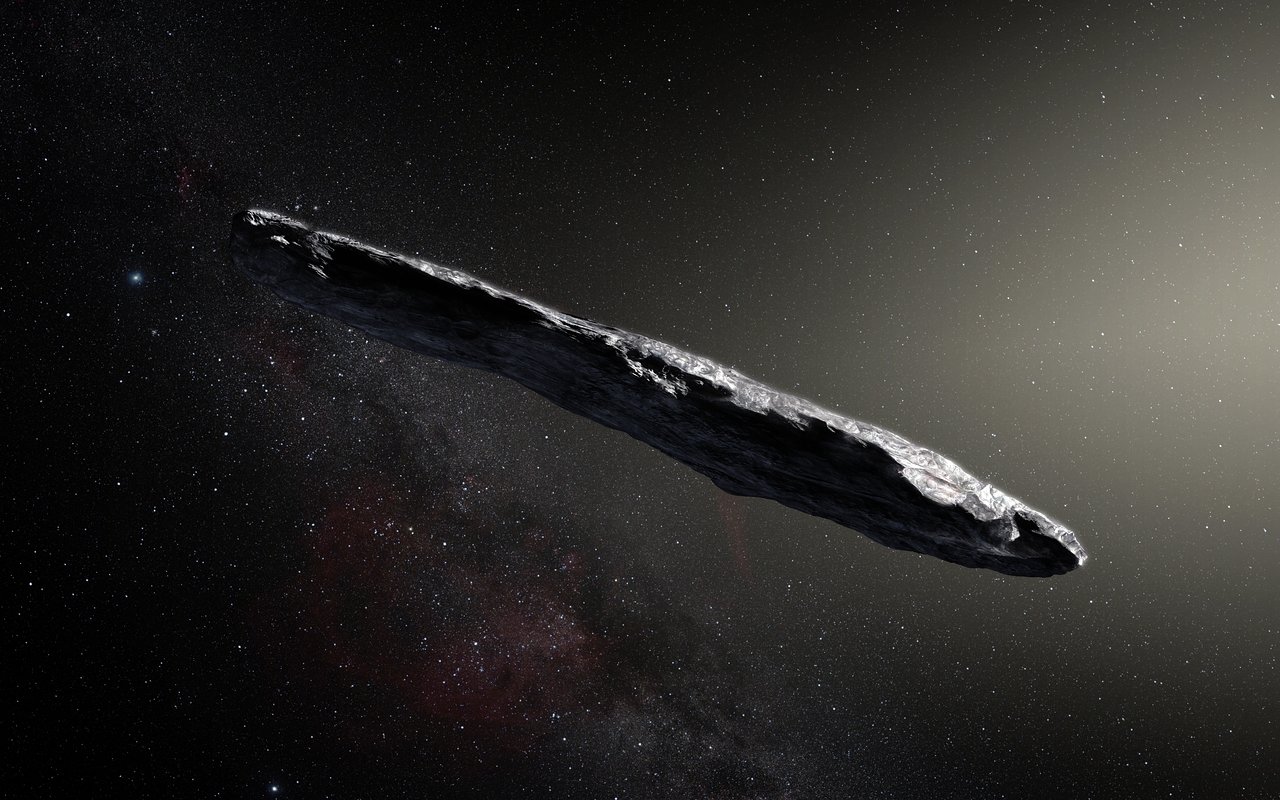
In October 2017, a Hawaiian telescope caught something that shouldn't have been there: a rock from another star system, already on its way out. ʻOumuamua was cigar-shaped, tumbling, reddish — and then it sped up as it left, with no comet tail to explain why. The consensus says faint outgassing we couldn't see. One Harvard astronomer says: don't rule out that someone built it.
Most likely a natural object
Acceleration still unexplained
10 supported
A scout from somewhere else
On October 19, 2017, astronomer Robert Weryk was working through images from the Pan-STARRS telescope on Maui when he found something moving too fast — not a-little-fast, but impossibly fast for anything bound to our Sun. It was the first confirmed interstellar object ever detected: a fragment of some other solar system, falling through ours on a hyperbolic path that would never bring it back.
The name they gave it, ʻOumuamua, is Hawaiian for a scout or messenger reaching out from the distant past. It fit. By the time we spotted it, the object had already rounded the Sun — perihelion was forty days earlier, inside the orbit of Mercury — and was accelerating back toward interstellar space. We had a few weeks of observing time. Then it would be gone for good.
▸ Orbit: NASA/JPL · schematic, ecliptic projection
Almost everything about it was wrong
ʻOumuamua broke the mold in nearly every measurement. Its brightness swung by a factor of ten as it tumbled, which implies an extreme shape — somewhere between five and ten times longer than it was wide, a cosmic cigar (or a pancake, depending on whose model you trust). It was reddish, the color of a surface baked by cosmic radiation over a very long time. And despite passing close to the Sun, it showed no comet tail, no coma, no detectable outgassing of any kind.
Then, on the way out, it sped up. Not by much — but measurably, more than the Sun's gravity alone could account for, confirmed by Hubble tracking. For a comet this is routine: venting gas acts like a tiny thruster. But ʻOumuamua vented nothing anyone could see. The push was real. The usual cause was missing.
Two ways to explain a push with no exhaust
NASA and JPL reclassified it from asteroid to comet and attributed the acceleration to outgassing — hydrogen or other volatiles too faint for our instruments to catch. Reasonable. Also unproven, because we never actually detected the gas.
In 2018, Harvard's Shmuel Bialy and Avi Loeb ran the other number: what if the push was sunlight? Solar radiation pressure could account for the acceleration if ʻOumuamua were extraordinarily thin — about a millimeter — and broad, like a sail. A natural object that thin would be absurdly fragile. An engineered one would not. They did not claim it was built. They said the data did not rule it out.
The definitive review arrived in 2019, when fourteen scientists convened at the International Space Science Institute specifically to settle the question. Their verdict: everything observed is consistent with a natural body, and there is no evidential basis for an artificial one.
Venting gas — hydrogen or other volatiles too faint to detect — acted like a thruster, exactly as it does for ordinary comets. NASA/JPL reclassified ʻOumuamua from asteroid to comet on this basis.
No gas, dust, coma, or tail was ever actually detected. The cause is inferred, never observed.
Sunlight could supply the push if ʻOumuamua were ~1 mm thin and sail-broad. A natural object that thin would be impossibly fragile; an engineered one would not. Bialy & Loeb argued only that the data didn't rule it out.
Requires a structure with no analogue in any known natural process. The 2019 ISSI review found no evidential basis for it.
The record is closed
Here's the uncomfortable part: both explanations require something we have never seen. A hydrogen iceberg, a nitrogen shard, a fractal dust aggregate — the exotic-but-natural candidates each fit some of the data and none of it cleanly. The sail fits the acceleration and nothing else in nature. The honest position is that ʻOumuamua was genuinely strange, the consensus is the safer bet, and the one measurement that would have closed the case — the gas — was never made.
And it never will be. ʻOumuamua is beyond the reach of any instrument we have or plan to build. The few weeks of data from late 2017 are the entire scientific record, permanently. The second interstellar visitor, Borisov, turned up in 2019 looking like a perfectly ordinary comet — which only makes the first one stranger.
NASA committee report reviewed passage 1 states that 1I 2017 U1 Oumuamua was discovered by Pan-STARRS survey operations, moved on a hyperbolic trajectory, and became a useful case for interstellar-object follow-up planning.
Source-native evidence with extracted text available for story structure.
How we know this
Built from 5 sources — 4 first-hand · 1 background & context, incl. 2 academic / technical. 1 of the 6 figures here is drawn directly from those sources.
- 'Oumuamua — NASA Science (overview)Public record — free to reuseaccessed 2026-05-21
- Our Solar System's First Known Interstellar Object Gets Unexpected Speed Boost — NASA SciencePublic record — free to reuseaccessed 2026-05-21
- 1I/'Oumuamua — WikipediaCreative Commons — reuse allowed with attribution, share-alikeaccessed 2026-05-21
- Bialy & Loeb (2018) — Could Solar Radiation Pressure Explain 'Oumuamua's Peculiar Acceleration? (arXiv preprint)Quoted or summarized under fair use — follow the link for the originalaccessed 2026-05-21
- 'Oumuamua ISSI Team (2019) — The Natural History of 'Oumuamua, Nature Astronomy (arXiv preprint)Quoted or summarized under fair use — follow the link for the originalaccessed 2026-05-21
This account draws on publicly available sources and historical records. Report a factual error → How we source and correct →
The Case File
PROBABLY EXPLAINEDWhat's still open
The acceleration is real and Hubble-confirmed. The outgassing that would explain it was never detected. The solar-sail hypothesis fits that one measurement but requires a structure with no natural analogue. ʻOumuamua is gone, and the 2017 observing window is the complete and final record.
What would change our mind
A second ʻOumuamua-class object — extreme shape, non-gravitational acceleration, and zero detectable outgassing — caught early enough to measure the gas directly. Borisov (2019) was an ordinary comet; the anomaly hasn't recurred.