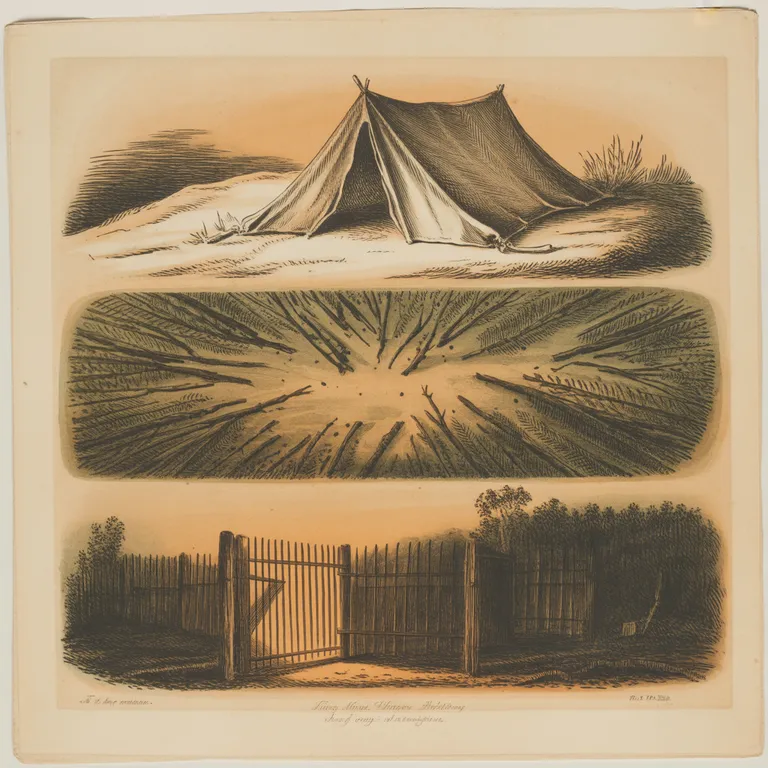
Nine hikers cut their tent from inside. Then died in the snow.
On the night of February 1, 1959, nine Soviet ski hikers cut their way out of their tent on the Dyatlov Pass, ran into a sub-zero snowstorm without their boots, and died spread across a kilometer of slope. The autopsy found two with crushed chests and a third with her tongue missing. The Soviet investigation closed the case citing 'a compelling natural force.' Russia reopened it in 2019 and concluded in 2020 that an avalanche was responsible — an explanation that fits almost none of the physical evidence the original investigators recorded.
Avalanche theory contradicts the slope angle, the tent placement, and the injury pattern.
On the night of February 1, 1959, nine Soviet hikers led by Igor Dyatlov cut their tent open from the inside and fled into a -25°C blizzard on the eastern slope of Kholat Syakhl in the northern Urals. All nine died. Bodies were recovered over four months. Two had skull fractures; one had crushing chest injuries; clothing on three carried traces of radioactivity. The case stayed officially unsolved for sixty years.
In late March 1922, six people — the Gruber family and their newly arrived maid — were killed with a farm mattock at the isolated Hinterkaifeck farmstead in Bavaria. Strange events preceded the murders, and someone evidently stayed at the farm for days afterward, feeding the livestock. Despite a decades-long investigation, no one was ever charged, and the case remains Germany's most famous unsolved murder.
On the morning of June 30, 1908, an explosion equivalent to roughly 10–15 megatons of TNT flattened approximately 2,150 km² of Siberian taiga near the Stony Tunguska River. No crater was found. The first scientific expedition reached the site nineteen years later. The leading explanation today — a stony asteroid airburst at ~5–10 km altitude — fits most of the physical evidence, though competing hypotheses about composition (cometary, stony, carbonaceous) are still debated.
In December 1872 a passing ship found the Mary Celeste sailing the Atlantic alone — seaworthy, stocked with six months of food, and completely empty. Ten people and one lifeboat were gone. A Gibraltar court suspected foul play and could prove none. A century and a half later, the best answer is still a careful guess.
In 1587 about 115 English colonists settled on Roanoke Island; Governor John White sailed home for supplies, and war with Spain stranded him in England for three years. He returned in 1590 to an empty, orderly settlement — the only clue the word 'CROATOAN' carved into a post. The colonists were never found. Most historians think they assimilated with nearby Indigenous communities, but the case remains genuinely unsolved.
The Bermuda Triangle is a vaguely bounded stretch of the western Atlantic — roughly Miami, Bermuda, and Puerto Rico — where ships and planes are said to vanish without explanation. The truth is less spooky: NOAA, the Coast Guard, and Lloyd's of London find no unusual danger, and researcher Larry Kusche showed the 'mystery' was built from sloppy reporting, omitted storms, and incidents that happened elsewhere. The real anomaly is how a myth this thin traveled this far.