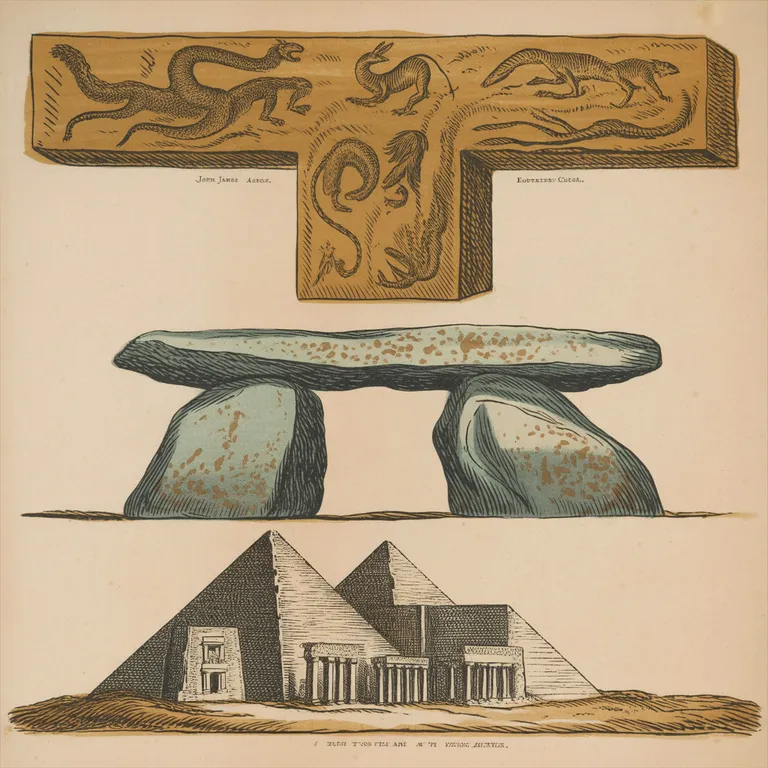
Built 11,500 years ago. Buried by the builders. Why?
Göbekli Tepe sits on a hill in southeastern Turkey and shouldn't exist. The T-shaped limestone pillars are older than agriculture, older than pottery, older than writing — twelve millennia old, carved by people who hunted with stone tools. After about 1,500 years of use the builders backfilled the entire complex with rubble and walked away. We have no settled explanation for why they built it, or for why they so deliberately buried it.
Predates the wheel by about 6,000 years.
In November 2025, a Binghamton team flew 22,000 drone photos over Rano Raraku, built a centimeter-accurate 3D model, and mapped 30 independent moai carving workshops — parallel clan operations, not a centralized workforce. This dismantles Jared Diamond's ecocide collapse narrative, which had already been undermined by 2024 ancient-DNA work. A third turn: experimental physics shows the moai were walked upright on ropes to their platforms.
The calfskin is soft — the kind of soft a book gets from being thumbed for years. Someone used this thing. Someone in the early 1400s handled it enough to wear the parchment smooth, filled 240 pages with a script no one has read since, and then history lost the plot entirely.
The four sides of the Great Pyramid of Giza are aligned to the cardinal directions with an average error of about 4 arcminutes — better than 1/15th of a degree. Built around 2580–2560 BCE without iron tools, magnetic compasses, or modern surveying equipment. How its 4th-Dynasty builders achieved that precision is a real open archaeological question; the leading hypothesis (Glen Dash, 2017) is an Indian Circle method on the autumnal equinox, but it isn't the only candidate.
In 1901, sponge divers off the Greek island of Antikythera pulled a corroded lump of bronze from a Roman-era shipwreck. Over the next century it turned out to be a hand-cranked analog computer from roughly 100 BCE — predicting planetary positions, lunar phases, and eclipses with a gear train more sophisticated than anything else known until medieval Europe, fifteen hundred years later.
Carved limestone pillars in southeastern Turkey, raised around 9500 BCE by people who had no pottery, no writing, and no farms. Göbekli Tepe is older than Stonehenge by 6,000 years — and it suggests humans built monuments together before they settled down to grow food, flipping the standard story of how civilization began.
The Nazca Lines are a vast set of geoglyphs — animals, plants, and geometric shapes — etched into the desert of southern Peru by the Nazca culture roughly 2,000 years ago, made by clearing dark surface stones to reveal pale ground beneath. Archaeologists link them to ritual processions and water-and-fertility ceremonies; a 2024 AI-assisted survey nearly doubled the known count of figurative geoglyphs. A UNESCO World Heritage Site since 1994.
Stonehenge, on England's Salisbury Plain, is a Neolithic stone monument built in stages between roughly 3000 and 1600 BCE. It was a cremation cemetery and a ceremonial site aligned to the solstices. The real mysteries are engineering, not magic — how its builders moved giant sarsens from 25 km away, bluestones from Wales, and, per a 2024 study, the central Altar Stone all the way from Scotland.