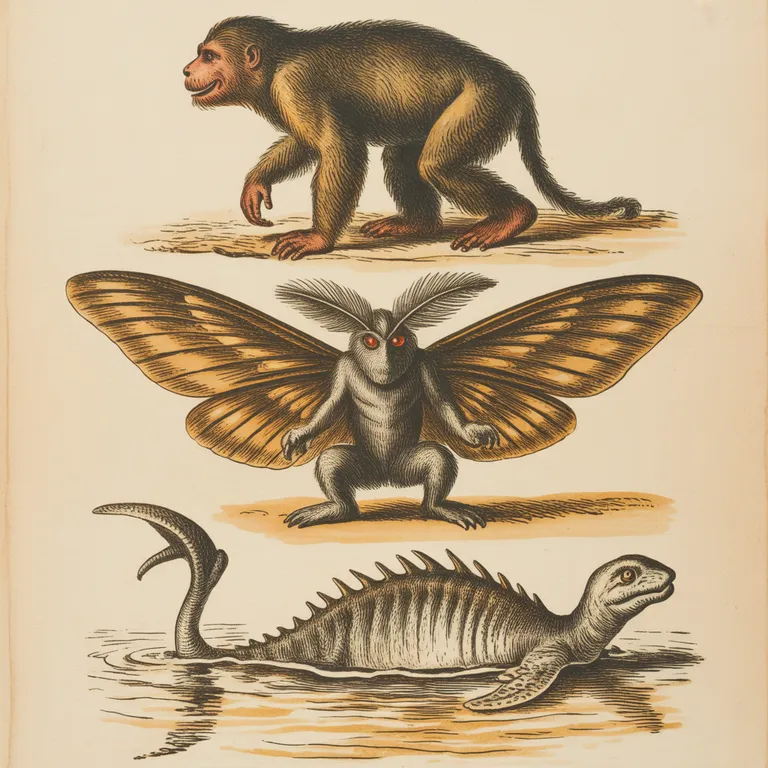
Washington State has never declassified Bigfoot.
Cryptids are the animals that field guides leave out because nobody can produce a specimen to museum standards. Bigfoot, Mothman, the Loch Ness creature, the Jersey Devil, Champ. Reports go back centuries; physical evidence does not. What does exist is institutional: Washington State has a Sasquatch policy on its books, county sheriffs in West Virginia keep Mothman files, and the Loch Ness has been the subject of three serious sonar surveys. Absence of a body is not absence of an investigation.
Killing one is a Class B felony in the county.
Patterson and Gimlin said they filmed a large bipedal figure at Bluff Creek on October 20, 1967. The grainy minute became Bigfoot's defining artifact. A 2026 documentary now presents an alleged 1966 rehearsal reel and Patterson-family testimony as evidence of staging, turning a long-running argument into a specific reel-authentication question.
Between November 1966 and December 1967, residents of Point Pleasant, West Virginia reported repeated encounters with a roughly seven-foot-tall winged humanoid with glowing red eyes — most often near an abandoned WWII munitions complex. The sightings stopped, by most accounts, on December 15, 1967 — the day the Silver Bridge across the Ohio River collapsed during rush hour, killing 46 people.
Modern Loch Ness sightings begin in 1933 with a road-construction crew's report and a newspaper article that gave the creature its nickname. Hundreds of eyewitness accounts, photographs, and sonar contacts have followed across ninety-plus years. Three exhaustive scientific surveys — Edward Mountain 1934, Operation Deepscan 1987, Neil Gemmell's eDNA study 2018–19 — found no evidence of a large unknown vertebrate, but none could fully account for every sighting or sonar return.
The chupacabra — Spanish for 'goat-sucker' — emerged from a 1995 wave of reports near Canovanas, Puerto Rico, where the original eyewitness described a spiny, red-eyed, alien-like beast. Folklorist Benjamin Radford traced that description to the 1995 sci-fi film Species. The later hairless 'dog' version from Texas and Mexico has been DNA-tested repeatedly: every carcass is a coyote or dog with mange. It is folklore — a real legend, no real monster.
The Jersey Devil is a winged, hooved, horse-headed creature said to haunt New Jersey's Pine Barrens. Folklore says 'Mother Leeds' cursed her thirteenth child around 1735, birthing a monster that flew into the pines. Historians instead trace the 'Leeds Devil' to a colonial smear campaign against the real Leeds family — printers tangled in Quaker feuds and a satirical spat with Benjamin Franklin. A 1909 sighting panic, fueled by newspapers and a fake-winged-kangaroo hoax, sealed the legend.