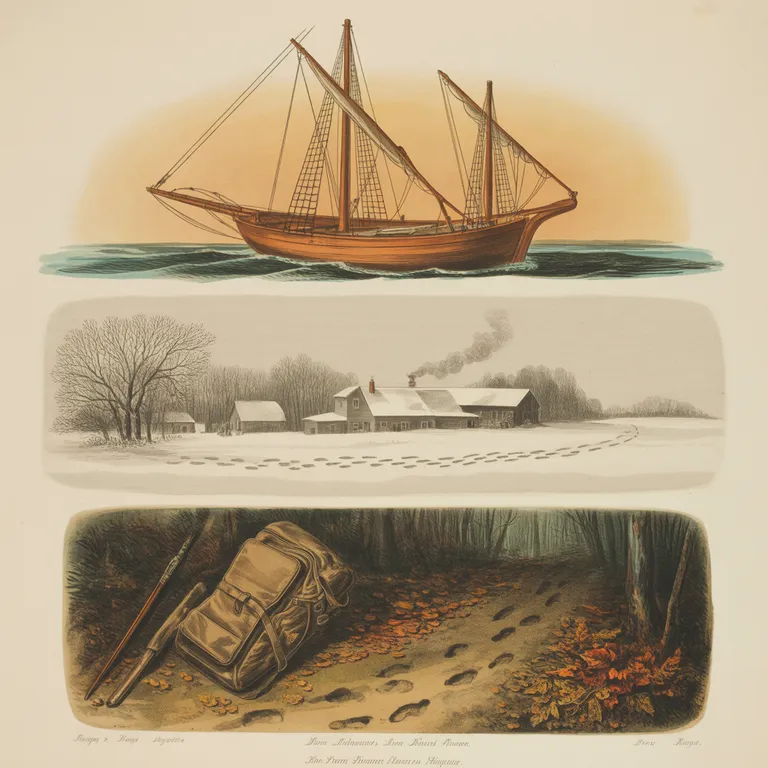
Found with the table set and the lifeboat gone.
The Mary Celeste was discovered in December 1872 drifting in the Atlantic between the Azores and Portugal with her cargo of denatured alcohol intact, the captain's last log entry ten days old, and no sign of her seven-person crew. The lifeboat was missing. No bodies, no blood, no distress signal, no piracy markers were ever found. The official inquiry concluded with no determinable cause. A century and a half later, the case has accumulated dozens of theories — none of them supported by physical evidence sufficient to close the file.
Crew of 7. Bodies recovered: 0.
A bourbon and 7-Up, a black clip-on tie, and a note that read, in neat felt-tip capitals: "Miss—I have a bomb in my briefcase and want you to sit by me." Then a man in a business suit stepped out the back of a Boeing 727 into a moonless November night and became the only person to hijack a U.S. airliner and get away with it. Fifty-plus years later, the FBI still can't tell you his name.
On December 1, 1948, a well-dressed man was found dead on Somerton Beach, Adelaide. No ID. Labels cut from his clothes. A scrap in his pocket read 'Tamám Shud' — the closing line of the Rubaiyat. The book it came from turned up in a nearby car, with a phone number and a coded message inside. The case stood open for 74 years. In 2022, Colleen Fitzpatrick and Derek Abbott matched DNA from preserved hair to Carl Webb, born Melbourne 1905.