
The GoFast Video
A 2015 Navy infrared clip shows an object screaming low across the ocean — the crew can be heard losing it. GoFast became one of the most-shared UAP videos on Earth. Then the math caught up: a prominent skeptic and the Pentagon's own UAP office both concluded the breakneck speed is an illusion of parallax. The object is slow, and far higher than it looks.
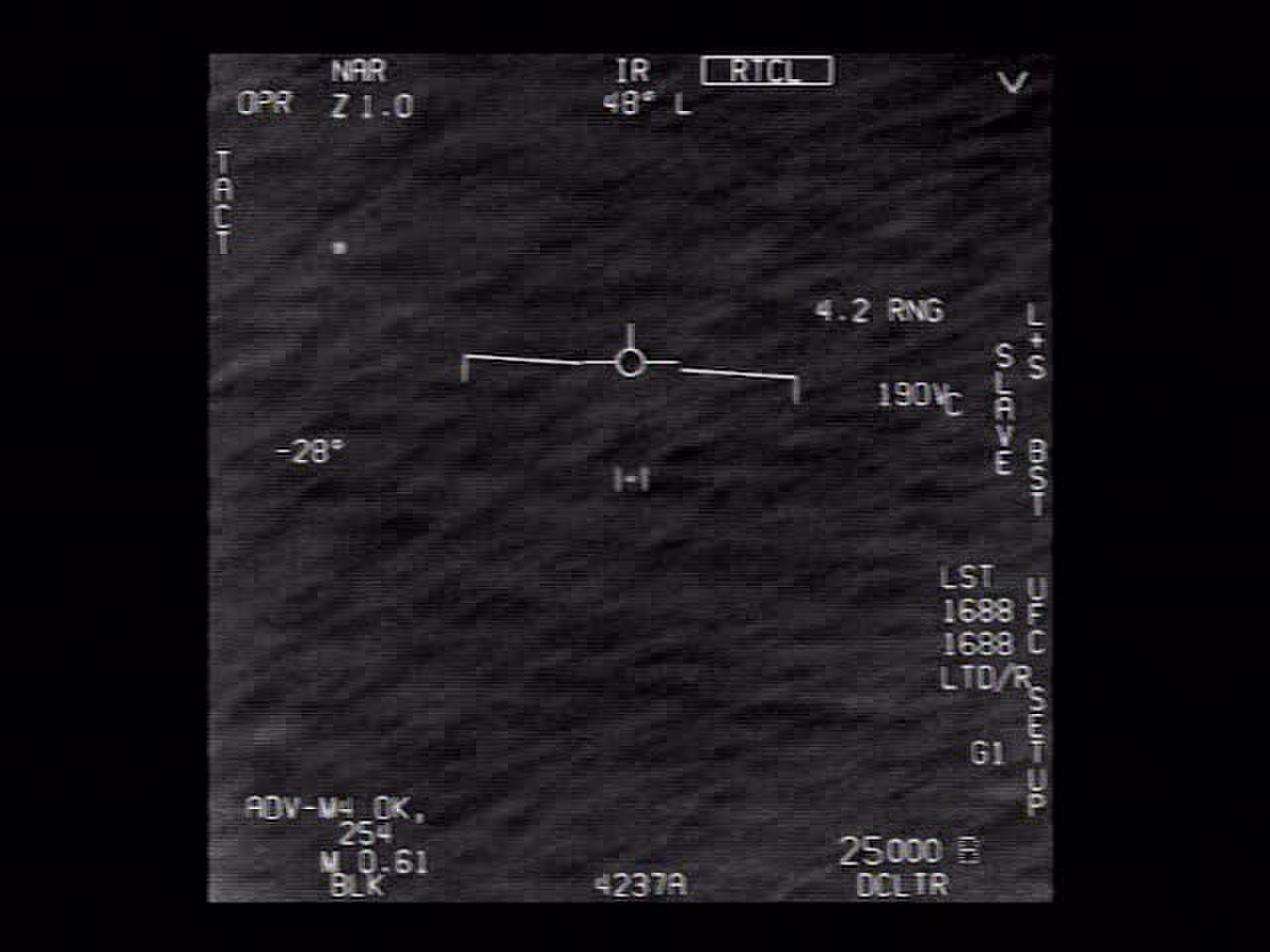
- U.S. Department of Defense2020-04-27
Authentic footage; object characterized as unidentified
- Metabunk (Mick West)2018
Not anomalous — likely a balloon; the apparent speed is a parallax illusion
- Pentagon All-domain Anomaly Resolution Office (AARO)2024-11
Resolved — non-anomalous; a slow object near 13,000 feet, apparent speed explained by motion parallax
Our read
Evidence — 8 claims
7 supported · 1 open
Sources — 4
4 sources · government records + journalism + reference
Partially explained
Parts of the case have strong explanations; other claims remain unsettled.
- SupportedGoFast footage was filmed by a U.S. Navy F/A-18 crew in January 2015 over the Atlantic warning area.
- SupportedThe DoD officially released GoFast alongside FLIR1 and GIMBAL on April 27, 2020, confirming the footage was genuine.
- SupportedAt time of release, the DoD confirmed the objects were unidentified but offered no explanation for what they were.
- SupportedMick West concluded the object's apparent speed is a parallax illusion and placed it near 13,000 feet moving slowly.
- SupportedAARO presented GoFast as resolved and non-anomalous at a November 2024 Senate hearing, citing motion parallax.
- SupportedAARO published its parallax methodology publicly so independent parties could verify the analysis.
- SupportedAARO's working hypothesis for the GoFast object is a balloon near 13,000 feet altitude.
- OpenThe specific identity, launch origin, or nature of the GoFast object has not been officially confirmed.
What remains unexplained
The speed illusion is resolved. The object's precise identity is not. AARO's 'balloon' hypothesis fits the geometry but hasn't been confirmed with a specific identification.
- 01No official investigation has named a specific object, launch site, or operator for the GoFast target.
- 02The parallax methodology resolves the motion anomaly but leaves the object technically unidentified.
- 03GoFast raises a broader methodological question about how FLIR footage should be interpreted without geometric analysis.
January 2015. Somewhere over the Atlantic warning area off the U.S. East Coast, a Navy F/A-18 crew locks an infrared camera onto a small object skimming low across the ocean. The crew is audibly delighted. "Whoa, got it!" The object moves fast — or appears to. That appearance is almost everything the GoFast story turns on.
What this record is built from
4 sources grouped by provenance class.
4
cited sources
- 01
Government / agency
1 record
primary · 1 - 02
Reporting
2 records
secondary · 2 - 03
Reference
1 record
context · 1
Key sources
- K1government-agency / primary Statement by the Department of Defense on the Release of Historical Navy Videos (April 27, 2020)
- K2journalism / secondary DefenseScoop — Pentagon's UAP office reviews GoFast findings at Senate hearing (November 2024)
What happened
The clip is 34 seconds. A FLIR pod tracks a white shape moving rapidly across the water's surface — or what looks like the water's surface. The pilots can't identify it. The footage circulated privately for years before the New York Times and To The Stars Academy released it in 2017 alongside FLIR1 and GIMBAL. On April 27, 2020, the Department of Defense officially released all three videos, confirming the footage was genuine and the objects were unidentified. The War Zone covered the release and noted the DoD offered no explanation for what the objects were — just that the footage was real.
GoFast became one of the most-shared UAP clips on the internet. The apparent speed and low altitude made it feel like the most concrete of the three Pentagon videos. It was the one where something seemed to be doing something.
How the case was observed
2 observation modes on record.
2
modes
- S01
FLIR
Instrument
- S02
Photographic
Recording
Instrument
1
Recording
1
The evidence
Then Mick West ran the math. His reconstruction, using the jet's known speed, altitude, and the FLIR zoom level, concluded the apparent breakneck velocity is a parallax illusion. When a fast-moving aircraft films a distant object at high magnification, the object appears to race across the frame — even if the object itself is nearly stationary. West placed the object at roughly 13,000 feet altitude, moving slowly. Not screaming across the water. Floating.
The Pentagon's own All-domain Anomaly Resolution Office reached the same conclusion. At a November 2024 Senate hearing, AARO presented GoFast as resolved — a slow-moving object near 13,000 feet whose apparent speed is fully explained by motion parallax. Critically, AARO published its methodology so anyone could check the math. The office characterized the object as non-anomalous. Its best guess: a balloon.
Two independent analyses — one from a prominent civilian skeptic, one from the government's own UAP office — landed in the same place using the same geometric reasoning. That's a meaningful convergence. The speed was never real. The altitude was never low.
What the explanations don't explain
The parallax case is solid. What it doesn't resolve is what, specifically, the object was. "Balloon" is the working hypothesis, not a confirmed identification. AARO's methodology explains the motion — it doesn't produce a tail number or a launch site. The object remains technically unidentified in the narrow sense: we know what it probably wasn't doing, but not precisely what it was.
There's also a broader question the GoFast resolution quietly raises. If the most dramatic-looking of the three Pentagon videos turns out to be a slow balloon seen through a parallax lens, what does that suggest about how we interpret FLIR footage in general? The sensor that makes these objects look anomalous is the same sensor that can produce the illusion. That's not a reason to dismiss every clip — it's a reason to run the geometry before drawing conclusions.
What's still open
GoFast is the Pentagon UAP video with the clearest resolution on record. The speed was an illusion. The altitude was wrong. The object was probably mundane. What it was, exactly, nobody has officially confirmed. The record closes most of the mystery and leaves a small, unexciting remainder: an unidentified slow-moving object at cruise altitude that a Navy crew couldn't place in the moment. That's the honest version.
What is the GoFast UAP video?
GoFast is a 34-second Navy infrared clip from January 2015 showing an unidentified object that appears to race low across the Atlantic Ocean. The Department of Defense officially released it in April 2020 alongside the FLIR1 and GIMBAL videos, confirming the footage was genuine but offering no explanation at the time.
Was the speed in the GoFast video real?
No — the apparent speed is a parallax illusion. When a fast-moving jet films a distant object at high zoom, the object appears to race across the frame even if it's nearly stationary. Both Mick West's independent reconstruction and AARO's 2024 Senate testimony placed the object near 13,000 feet, moving slowly.
What did AARO conclude about GoFast?
At a November 2024 Senate hearing, the Pentagon's All-domain Anomaly Resolution Office characterized GoFast as resolved and non-anomalous. AARO concluded the object was a slow-moving object near 13,000 feet — likely a balloon — and published its parallax methodology publicly so anyone could verify the analysis.
Has the GoFast object been definitively identified?
Not precisely. The motion and apparent speed have been explained by parallax geometry, and the working hypothesis is a balloon, but no official investigation has confirmed a specific object, launch origin, or tail number. The object remains technically unidentified in the narrow sense.
Why did GoFast look so dramatic if the explanation is mundane?
The FLIR pod's high zoom level combined with the jet's own speed created a strong parallax effect, making a slow, high-altitude object appear to skim the ocean surface at high velocity. It's a good reminder that the same sensor that captures anomalous-looking footage can also produce the illusion that makes it look anomalous.
UAP
USS Nimitz Encounter
Over two weeks in November 2004, U.S. Navy radar tracked an unidentified object off the California coast that maneuvered in ways no known aircraft could match. The pilot who saw it up close has been on the record ever since.
2004-11
UAP
The GIMBAL Video
In January 2015, an F/A-18's infrared camera caught a wingless oval object off the U.S. East Coast that appeared to slow, hover, and rotate in mid-air. The New York Times leaked the footage in 2017; the Pentagon confirmed it was real in 2020 — and still calls the object unidentified. Whether it shows a craft or a camera artifact is genuinely argued over.
2015-01
UAP
The Aguadilla Incident
On April 25, 2013, a U.S. Customs and Border Protection aircraft filmed a thermal-infrared sequence near Aguadilla, Puerto Rico, of a small object that appeared to fly low and fast, split in two, and dip toward the ocean. The Scientific Coalition for UAP Studies called it genuinely anomalous, while skeptics — and a 2025 Pentagon AARO report — argue it shows wind-drifting sky lanterns, with the 'speed' a parallax illusion and the 'water entry' a thermal-imaging artifact.
2013-04-25
U.S. Department of Defense
2020-04-27
Authentic footage; object characterized as unidentified
Official release of the FLIR1, GIMBAL and GoFast videos; confirmed genuine but offered no explanation for the object at the time.
Metabunk (Mick West)
2018
Not anomalous — likely a balloon; the apparent speed is a parallax illusion
Reconstructed the object near 13,000 feet moving slowly; the speed illusion comes from a fast jet filming at high zoom.
Pentagon All-domain Anomaly Resolution Office (AARO)
2024-11
Resolved — non-anomalous; a slow object near 13,000 feet, apparent speed explained by motion parallax
Presented at a November 2024 Senate hearing; AARO published its parallax methodology so the public could check the math.
- Statement by the Department of Defense on the Release of Historical Navy Videos (April 27, 2020)Public record — free to reuseaccessed 2026-05-21
- The War Zone — Navy Officially Releases Controversial UFO Videos (April 2020)Quoted or summarized under fair use — follow the link for the originalaccessed 2026-05-21
- DefenseScoop — Pentagon's UAP office reviews GoFast findings at Senate hearing (November 2024)Quoted or summarized under fair use — follow the link for the originalaccessed 2026-05-21
- Pentagon UFO videos — WikipediaCreative Commons — reuse allowed with attribution, share-alikeaccessed 2026-05-21
This account draws on publicly available sources and historical records. Report a factual error → How we source and correct →