
USS Nimitz Encounter
Over two weeks in November 2004, U.S. Navy radar tracked an unidentified object off the California coast that maneuvered in ways no known aircraft could match. The pilot who saw it up close has been on the record ever since.
What this record is built from
3 sources grouped by provenance class.
3
cited sources
- 01
Government / agency
2 records
primary · 2 - 02
Reporting
1 record
secondary · 1
Key sources
- K1government-agency / primary DoD AOIMSG — Statement on the release of historical Navy videos
- K2government-agency / primary Cmdr. David Fravor — congressional testimony before the House Oversight Subcommittee (2023)
Our read
Evidence — 8 claims
5 supported · 1 resolved · 1 contested · 1 open
Sources — 3
3 sources · government records + journalism
Contested
Competing readings of the record remain live.
- SupportedUSS Princeton's SPY-1 radar tracked unidentified objects descending from ~80,000 ft to 20,000 ft for two weeks before the visual intercept.
- SupportedCmdr. David Fravor observed a white, wingless, ~40-foot Tic Tac-shaped object with no visible propulsion during the intercept.
- SupportedThe object mirrored Fravor's maneuvers then accelerated away, reappearing ~60 miles away at the CAP point almost immediately.
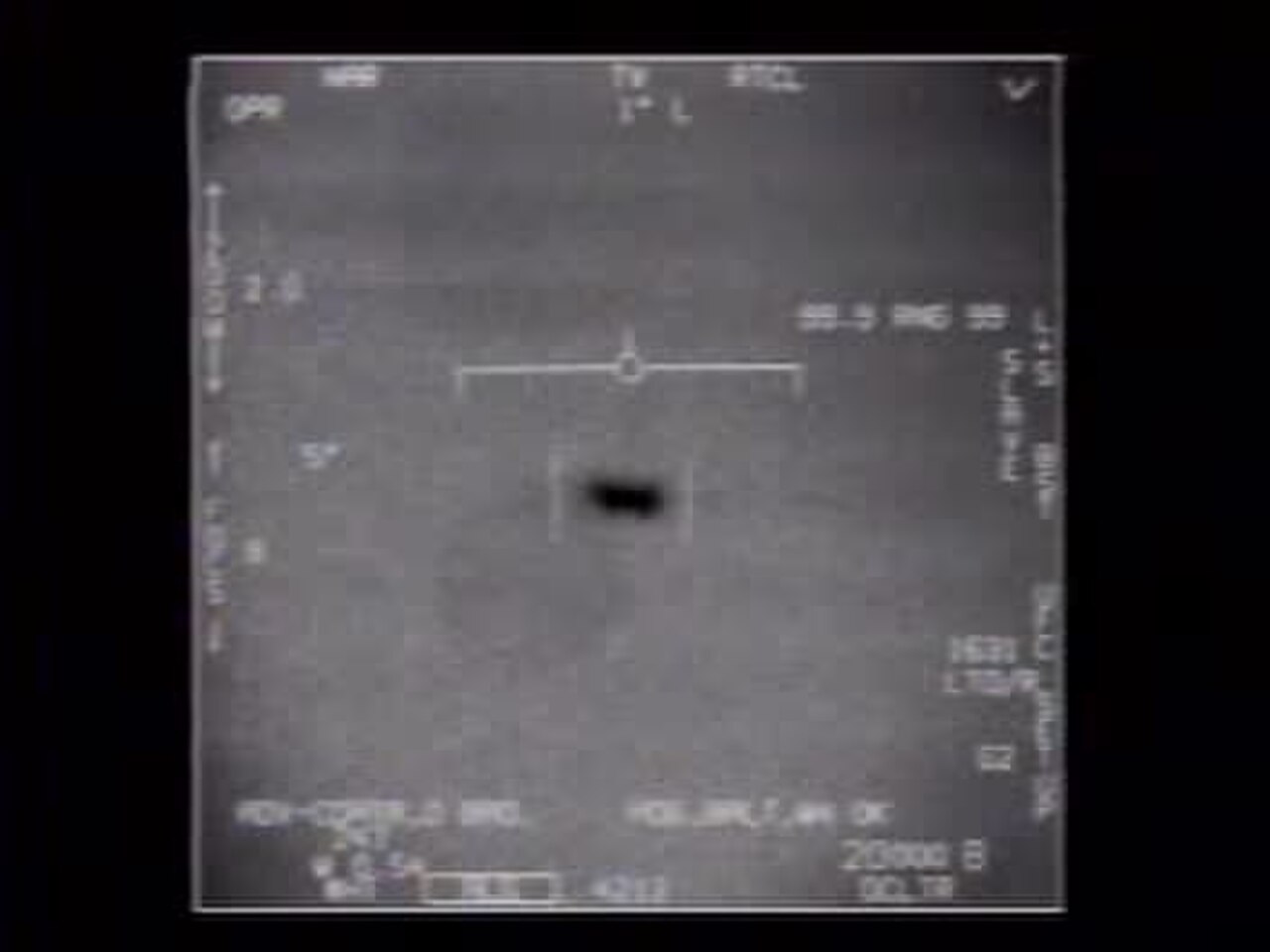
- ResolvedThe DoD confirmed in 2020 that the FLIR1 and other Navy videos are authentic and the phenomena depicted remain unidentified.
- SupportedAATIP, a Pentagon UAP program partly funded through Sen. Harry Reid, studied the Nimitz encounter; its existence was revealed by the NYT in 2017.
- ContestedMick West has argued the FLIR1 footage is consistent with a gimbal artifact from the infrared sensor, not a rotating object.
- SupportedFravor testified under oath before the House Oversight Subcommittee in 2023 and has not changed his account in twenty years.
- OpenThe full SPY-1 radar data from the Princeton has not been publicly released.
What remains unexplained
The DoD confirms the videos are real and the object unidentified. The two-week radar record is largely undisclosed. No physical evidence exists. What the object was, and where it came from, remains officially open.
- 01The SPY-1 radar data from the Princeton covering two weeks of contacts has not been released to the public.
- 02No physical evidence or recovered material from the encounter has been disclosed.
- 03The object's origin, propulsion, and behavior during the full two-week window remain unexplained in any public official record.
Pacific Ocean, 100 miles southwest of San Diego. November 2004. The USS Nimitz carrier strike group had been tracking an anomalous radar contact for two weeks before anyone got eyes on it.
What happened
The USS Princeton's SPY-1 radar — one of the most capable naval radar systems in service — had been picking up objects descending from roughly 80,000 feet to 20,000 feet, then hovering, then vanishing. No flight plan. No transponder signal. No explanation from air traffic control. After two weeks of this, the Princeton vectored a pair of F/A-18F Super Hornets toward one of the contacts to take a look.
Cmdr. David Fravor was leading that flight. What he describes — and has described consistently, including under oath before the House Oversight Subcommittee in 2023 — is a white, Tic Tac-shaped object, roughly 40 feet long, with no wings, no exhaust, no visible means of propulsion. It was hovering above a roiling patch of ocean. When Fravor maneuvered toward it, the object mirrored his movements, then accelerated away instantly. It reappeared at the Nimitz's combat air patrol rendezvous point — 60 miles away — almost immediately. Fravor called it the most advanced aircraft he'd ever seen. He also said it was nothing he could explain.
A second flight crew captured the encounter on FLIR — the infrared camera footage now known as FLIR1, or the "Tic Tac" video.
How the case was observed
4 observation modes on record.
4
modes
- S01
FLIR
Instrument
- S02
Radar
Instrument
- S03
Visual observation
Human
- S04
Photographic
Recording
Human
1
Instrument
2
Recording
1
The evidence
Three pieces of evidence anchor this case: the SPY-1 radar tracks from the Princeton, Fravor's eyewitness account, and the FLIR1 footage. The Department of Defense formally confirmed in 2020 that the videos are authentic and that the phenomena depicted remain unidentified. That's the first time the Pentagon used that language on record.
The 2017 New York Times investigation that broke the story publicly also revealed the existence of AATIP — the Advanced Aerospace Threat Identification Program — a Pentagon effort partly funded through Sen. Harry Reid that had been studying UAP encounters including Nimitz. The program's existence had not been publicly acknowledged before that piece.
What the explanations don't explain
Skeptic Mick West has made a credible case that the FLIR1 footage alone can be explained by a gimbal artifact — the rotating infrared sensor creating the appearance of a rotating object. That's a real phenomenon. It's worth taking seriously.
But the gimbal argument addresses the video. It doesn't address the SPY-1 radar tracks running for two weeks before the intercept. It doesn't address what Fravor saw with his eyes from an F/A-18 cockpit at close range. It doesn't address the object's apparent repositioning to the CAP point. Mick West's own analysis, notably, has not claimed to resolve the broader case — just the FLIR clip.
Fravor's congressional testimony in 2023 added detail that hasn't been walked back. He described the object's performance as beyond anything in the U.S. inventory or any adversary inventory he was aware of. He said it under oath. He has not changed his account in twenty years.
What's still open
The DoD has not identified the object. The radar data from the Princeton has not been fully released to the public. No physical evidence was recovered. The two-week pattern of radar contacts — the part of the case that precedes the famous video by fourteen days — remains almost entirely undocumented in the public record.
We know the videos are real. We know an experienced Navy pilot saw something he couldn't identify. We know the Pentagon's own program was studying this encounter. What the object was, where it came from, and what it was doing — nobody has said, officially or otherwise. That's where the record stops.
What did the USS Nimitz pilots actually see in 2004?
Cmdr. David Fravor described a white, Tic Tac-shaped object roughly 40 feet long with no wings, no exhaust, and no visible propulsion. It hovered, mirrored his flight maneuvers, then accelerated away instantly — reappearing 60 miles away at a pre-assigned rendezvous point almost immediately. He testified to this account under oath before Congress in 2023.
Did the U.S. government confirm the Nimitz UFO videos are real?
Yes. The Department of Defense formally confirmed in 2020 that the three Navy videos — including the FLIR1 'Tic Tac' footage — are authentic and that the phenomena depicted remain unidentified. That was the first time the Pentagon officially acknowledged the videos on the record.
Can the Nimitz FLIR footage be explained as a camera artifact?
Skeptic Mick West has argued that the rotating appearance in the FLIR1 clip is consistent with a gimbal artifact from the infrared sensor. That's a plausible explanation for the video itself. It doesn't account for the two weeks of SPY-1 radar contacts before the intercept, or Fravor's direct visual observation from the cockpit.
What was AATIP, the Pentagon program connected to the Nimitz case?
AATIP — the Advanced Aerospace Threat Identification Program — was a Pentagon effort partly funded through Sen. Harry Reid that studied UAP encounters including the Nimitz incident. Its existence was first publicly revealed by the New York Times in December 2017 and had not been officially acknowledged before that.
Has David Fravor ever changed his account of what he saw?
No. Fravor has described the same encounter consistently for nearly twenty years, across media interviews and formal congressional testimony in 2023. He testified under oath that the object's performance exceeded anything in the U.S. or known adversary inventory.
UAP
The GIMBAL Video
In January 2015, an F/A-18's infrared camera caught a wingless oval object off the U.S. East Coast that appeared to slow, hover, and rotate in mid-air. The New York Times leaked the footage in 2017; the Pentagon confirmed it was real in 2020 — and still calls the object unidentified. Whether it shows a craft or a camera artifact is genuinely argued over.
2015-01
UAP
The GoFast Video
A 2015 Navy infrared clip shows an object screaming low across the ocean — the crew can be heard losing it. GoFast became one of the most-shared UAP videos on Earth. Then the math caught up: a prominent skeptic and the Pentagon's own UAP office both concluded the breakneck speed is an illusion of parallax. The object is slow, and far higher than it looks.
2015-01
UAP
The Stephenville Sightings
In January 2008, dozens of residents around Stephenville, Texas — including a pilot and a constable — reported a huge, silent, fast-moving object with brilliant lights, some claiming jets gave chase. The Air Force first denied any aircraft were present, then confirmed ten F-16s were training nearby. A MUFON analysis of FAA radar reported an unidentified non-transponder track, while skeptics attribute the whole episode to jets and high-intensity flares.
2008-01-08
U.S. Department of Defense
2020-04-27
Unidentified — videos confirmed authentic; phenomena unexplained
First formal Pentagon acknowledgment that the videos depict real, unidentified phenomena.
Metabunk (Mick West)
2019
Partially explained — FLIR1 gimbal artifact plausible; SPY-1 radar tracks not addressed
Notable skeptical analysis focused on the FLIR clip; does not resolve the broader case.
- DoD AOIMSG — Statement on the release of historical Navy videosPublic record — free to reuseaccessed 2026-05-01
- Glowing Auras and 'Black Money': The Pentagon's Mysterious U.F.O. Program (NYT, 2017-12-16)Quoted or summarized under fair use — follow the link for the originalaccessed 2026-05-01
- Cmdr. David Fravor — congressional testimony before the House Oversight Subcommittee (2023)Public record — free to reuseaccessed 2026-05-01
This account draws on publicly available sources and historical records. Report a factual error → How we source and correct →
Affiliate links — if you buy through these links, we may earn a commission at no cost to you.