
Rapa Nui's 30 Moai Workshops: The Centralized-Society Story Was Wrong
In November 2025, a Binghamton team flew 22,000 drone photos over Rano Raraku, built a centimeter-accurate 3D model, and mapped 30 independent moai carving workshops — parallel clan operations, not a centralized workforce. This dismantles Jared Diamond's ecocide collapse narrative, which had already been undermined by 2024 ancient-DNA work. A third turn: experimental physics shows the moai were walked upright on ropes to their platforms.
Our read
Evidence — 7 claims
5 supported · 2 open
Sources — 3
3 sources · academic + journalism
Unresolved
The record does not support a single durable explanation.
- SupportedBinghamton team flew 22,000 drone photos over Rano Raraku and built a centimeter-accurate 3D model of the quarry
- SupportedThe 3D survey identified 30 distinct carving zones at Rano Raraku, consistent with independent clan workshops
- SupportedThe finding contradicts the centralized-workforce model associated with Jared Diamond's Collapse narrative
- SupportedA 2024 ancient-DNA study found no genetic signature of the catastrophic population collapse Diamond's ecocide model requires
- SupportedExperimental work demonstrated moai could be walked upright on ropes by coordinated teams, without log-roller infrastructure
- OpenThe walking-moai rope technique has been demonstrated experimentally but is not yet archaeologically confirmed at scale
- OpenMoai across the 30 workshops share consistent proportions and form despite being produced by separate groups
What remains unexplained
The centralized-collapse model is in serious trouble. What replaces it isn't settled: how 30 independent clan workshops maintained stylistic consistency, and what actually changed on Rapa Nui over time, remains open.
- 01How separate clan workshops maintained near-identical moai proportions and style across 30 independent operations is unexplained
- 02The rope-walking transport method is experimentally demonstrated but not confirmed by physical archaeological evidence at scale
- 03What actually caused social and demographic change on Rapa Nui — if not the Diamond ecocide — has not been established by the new research
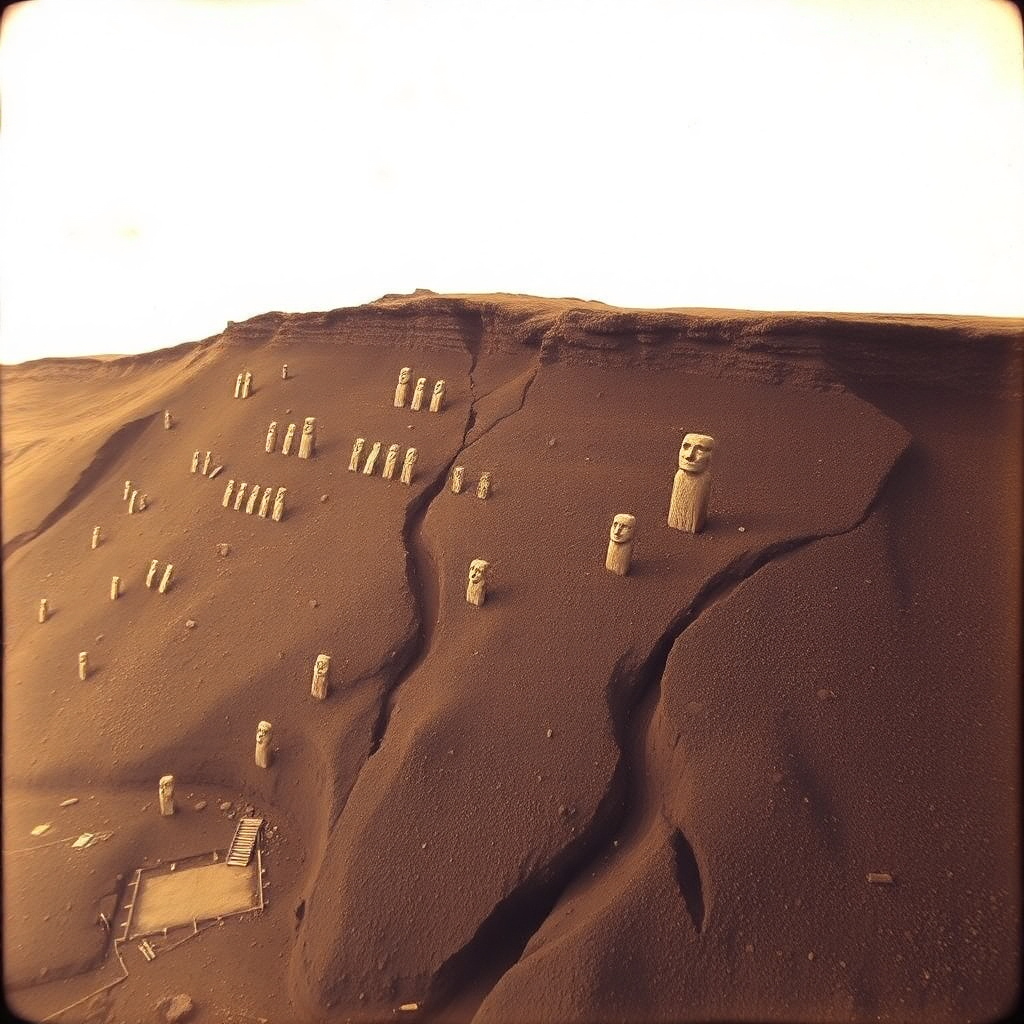
Rano Raraku quarry, Easter Island. November 2025. A Binghamton University team flew 22,000 drone passes over the volcanic slope where the moai were born, stitched the imagery into a centimeter-accurate 3D model, and found something that rewrites the standard story: 30 independent carving workshops, operating in parallel, belonging to separate clans.
The centralized-workforce model — one society, one quarry, one coordinated labor pool — is gone.
What happened
The prevailing narrative, popularized by Jared Diamond's Collapse, cast Rapa Nui as a cautionary tale: a society that exhausted its resources building moai for a centralized elite, then imploded. The archaeology underneath that story was always thinner than the prose suggested. The 2025 PLOS One study by Lipo et al. makes it thinner still.
What the drone survey found at Rano Raraku wasn't a single organized quarry operation. It was 30 distinct carving zones — separate workshops, spatially discrete, consistent with independent clan groups working their own sections of the slope simultaneously. Parallel production, not top-down command. The moai weren't monuments of a centralized state. They were, apparently, something more like competitive community projects.
This is the second major blow to the Diamond ecocide model in two years. A 2024 ancient-DNA study had already undermined the population-collapse narrative, finding no genetic signature of the catastrophic die-off the story requires. The 2025 quarry mapping is the structural complement: if the society wasn't organized the way Diamond described, the collapse mechanism he proposed doesn't have a foundation to stand on.
The evidence
The methodology here is worth pausing on. 22,000 drone photographs, processed into a 3D model with centimeter-level resolution. That's not a survey — that's a document. The spatial boundaries between carving zones are visible in the model, and the team mapped them as 30 discrete units rather than one continuous operation.
Separately, experimental physics work published in late 2025 addressed the other famous puzzle: how did the moai get from the quarry to their coastal platforms? The answer, per Archaeology Magazine, is that they walked. Not a metaphor — the statues were rocked upright on ropes by coordinated teams, moving in a controlled waddle across the landscape. The technique has been demonstrated experimentally. It works. It doesn't require the massive log-roller infrastructure the deforestation narrative depends on.
Two findings. Both pointing the same direction: the Rapa Nui people were resourceful, organized at the community level, and not destroying themselves in the process.
What the explanations don't explain
The clan-workshop model raises its own questions. Thirty parallel operations implies coordination of a different kind — not top-down, but horizontal. How did separate groups agree on the moai form? The statues are remarkably consistent across workshops: same proportions, same posture, same blank gaze toward the interior. That's either a very strong shared cultural template or something more structured than "independent clans doing their own thing." The record doesn't say which.
The walking-moai mechanism is experimentally demonstrated but not archaeologically confirmed at scale. Rope wear, anchor points, the logistics of moving statues across uneven terrain — the physical evidence for the specific method is still being assembled.
What's still open
The Diamond collapse narrative is in serious trouble. What replaces it isn't fully formed yet. The 2024 DNA work and the 2025 quarry mapping together suggest a society that was more resilient and more decentralized than the cautionary tale required — but the full picture of how Rapa Nui actually functioned, and what eventually changed there, remains open. Thirty workshops. One island. The question of how they talked to each other is still on the table.
What did the 2025 drone survey of Rano Raraku actually find?
A Binghamton University team processed 22,000 drone photographs into a centimeter-accurate 3D model of the Rano Raraku quarry and identified 30 spatially distinct carving workshops. The finding suggests moai were produced by independent clan groups working in parallel, not by a centralized workforce under elite direction. The study was published in PLOS One in November 2025.
How does this change the Jared Diamond Easter Island collapse story?
Diamond's *Collapse* argued that Rapa Nui society exhausted its resources building moai for a centralized elite and then imploded — an ecocide narrative. The 2025 quarry mapping shows no evidence of centralized production, and a 2024 ancient-DNA study found no genetic signature of a catastrophic population collapse. Together, they remove two of the story's main structural supports.
Did the Easter Island moai really 'walk' to their platforms?
Experimental physics work, covered by Archaeology Magazine in October 2025, demonstrated that the moai could be moved upright by rocking them on ropes — a coordinated waddle requiring teams but not the massive log-roller infrastructure the deforestation narrative depends on. The technique has been shown to work experimentally, though full archaeological confirmation at scale is still in progress.
What is the new model for how Rapa Nui society was organized?
The emerging picture is of a decentralized society organized at the clan level, with separate groups maintaining their own carving workshops and producing moai in parallel rather than under central coordination. This is more consistent with what the physical and genetic evidence now shows, though the full social structure of the island remains an open research question.
Why are the moai so consistent in style if 30 separate clans were making them?
That's the puzzle the new model creates. Thirty independent workshops produced statues with remarkably similar proportions, posture, and form — which implies either a very strong shared cultural template or some form of horizontal coordination between groups. The 2025 study identifies the workshops but doesn't fully resolve how stylistic consistency was maintained across them.
Ancient Mysteries
The Voynich Manuscript
The calfskin is soft — the kind of soft a book gets from being thumbed for years. Someone used this thing. Someone in the early 1400s handled it enough to wear the parchment smooth, filled 240 pages with a script no one has read since, and then history lost the plot entirely.
1430-01-01
Ancient Mysteries
The Alignment of the Great Pyramid
The four sides of the Great Pyramid of Giza are aligned to the cardinal directions with an average error of about 4 arcminutes — better than 1/15th of a degree. Built around 2580–2560 BCE without iron tools, magnetic compasses, or modern surveying equipment. How its 4th-Dynasty builders achieved that precision is a real open archaeological question; the leading hypothesis (Glen Dash, 2017) is an Indian Circle method on the autumnal equinox, but it isn't the only candidate.
-2580
Ancient Mysteries
The Antikythera Mechanism
In 1901, sponge divers off the Greek island of Antikythera pulled a corroded lump of bronze from a Roman-era shipwreck. Over the next century it turned out to be a hand-cranked analog computer from roughly 100 BCE — predicting planetary positions, lunar phases, and eclipses with a gear train more sophisticated than anything else known until medieval Europe, fifteen hundred years later.
-0100
- Lipo et al., 'Thirty carving zones in Rano Raraku quarry' — PLOS One (2025-11-26)Creative Commons — reuse allowed with attributionaccessed 2026-05-26
- ScienceDaily, 'Easter Island quarry: 30 independent carving workshops identified' (Nov 2025)Quoted or summarized under fair use — follow the link for the originalaccessed 2026-05-26
- Archaeology Magazine, 'Easter Island's Moai Statues Really Walked' (Oct 2025)Quoted or summarized under fair use — follow the link for the originalaccessed 2026-05-26
This account draws on publicly available sources and historical records. Report a factual error → How we source and correct →